
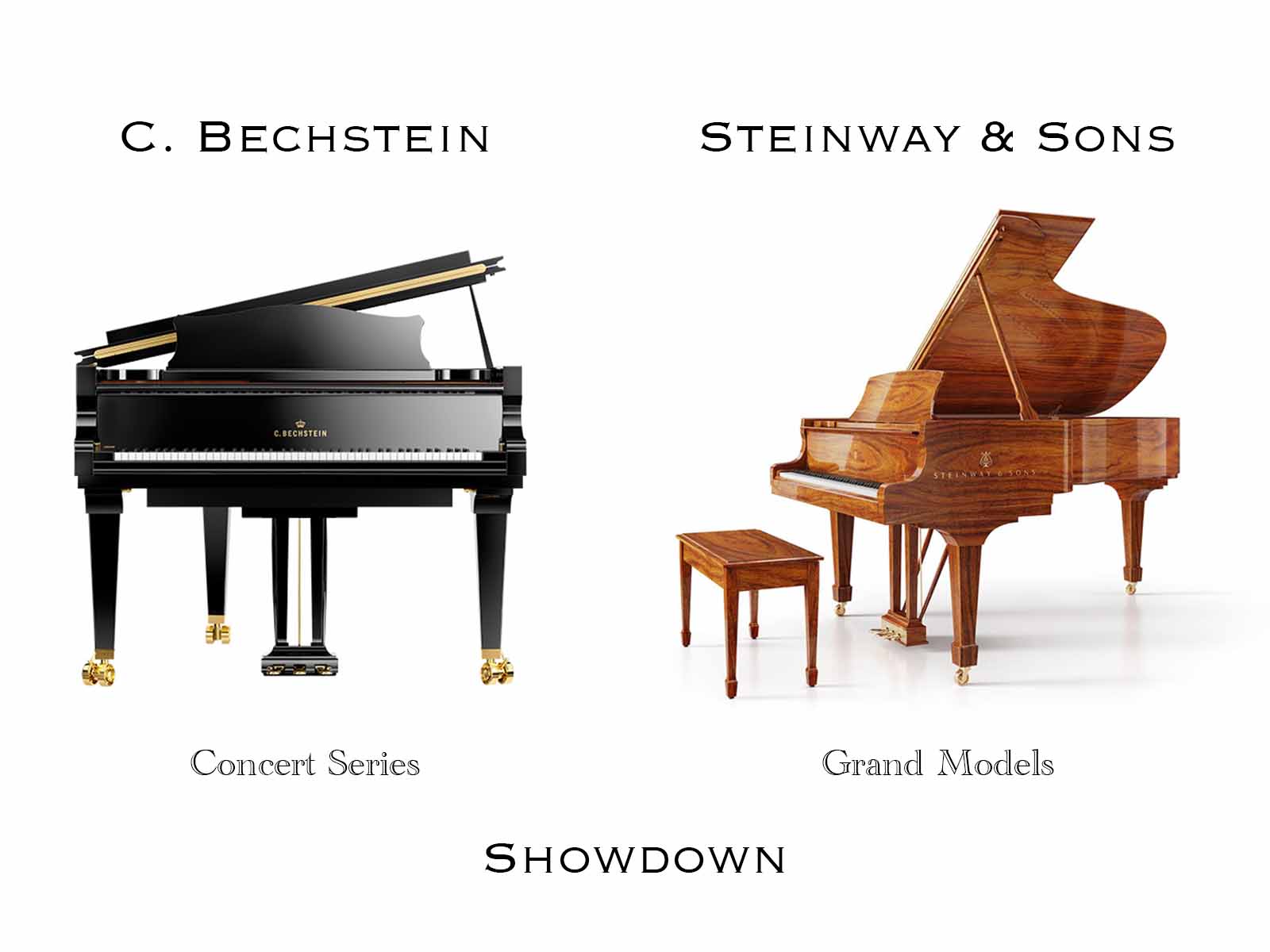
Two Icons. Two Voices. One Conversation. – C. Bechstein and Steinway & Sons
When pianists compare great grand pianos, the discussion quickly moves beyond specifications and into something more personal. Sound becomes character, touch becomes language. Few comparisons capture this better than C. Bechstein Concert Series grand pianos and Steinway & Sons grand pianos. Both are among the finest instruments in the world, yet they speak with very different voices.
C. Bechstein’s Concert Series reflects a distinctly European approach to tone. These pianos are known for their warmth, color, and lyrical depth. Rather than overwhelming a room, the sound unfolds gradually, revealing rich harmonics and a vocal quality that feels almost human. The treble sings, the midrange blooms, and the bass supports with elegance rather than force. For pianists who value phrasing, color, and expressive nuance, a Bechstein can feel deeply inviting.
Steinway & Sons approaches sound with a broad, commanding vision. The Steinway voice is clear, powerful, and designed to project effortlessly, even in large concert halls. Each note carries a strong fundamental, giving the instrument clarity, balance, and authority across every register. This versatility is a key reason Steinway has become the global standard on concert stages and in conservatories.
The contrast is also felt in touch. Bechstein Concert Series actions tend to be highly sensitive, responding immediately to subtle variations in finger weight and encouraging tonal exploration. Steinway actions feel solid and dependable, supporting wide dynamic ranges, fast repetition, and technically demanding repertoire. One invites intimacy; the other inspires confidence and control.
Where these pianos shine often depends on the setting. Bechstein Concert Series grands excel in recital halls and chamber music environments, where tonal color and nuance take center stage. Steinways thrive in large venues and collaborative performances, where projection and adaptability are essential.
In the end, choosing between them is not about right or wrong, but about which voice resonates most with the way you play and the way you listen.
C. Bechstein Concert Series vs Steinway & Sons Grand Pianos
| Feature | C. Bechstein Concert Series | Steinway & Sons Grand Pianos |
|---|---|---|
| Origin | Germany | USA (New York) & Germany (Hamburg) |
| Philosophy | Tonal beauty, lyricism, and expressive nuance | Power, versatility, and universal performance |
| Overall Tone | Warm, singing, richly colored | Clear, bold, and dynamically expansive |
| Harmonic Character | Complex overtones with vocal quality | Strong fundamental with controlled brilliance |
| Projection | Refined, intimate projection | Exceptional projection for large halls |
| Touch Feel | Highly sensitive, nuanced, slightly lighter feel | Balanced, solid, and consistent across dynamics |
| Action Response | Encourages tonal shaping and color control | Built for repetition, power, and technical demand |
| Dynamic Range | Wide but favors expressive shading | Extremely wide, from whisper-soft to thunderous |
| Repertoire Strengths | Romantic, impressionistic, chamber music | Classical, romantic, contemporary, concerto work |
| Concert Hall Use | Favored in European recital settings | Global concert-hall standard |
| Artist Appeal | Pianists seeking poetry and tonal depth | Pianists needing flexibility and projection |
| Aesthetic Style | Elegant, refined, understated luxury | Classic, authoritative, iconic |